
Blog
AI Dashcams vs Traditional Dashcams: Which Is Better for Fleet Safety?

Introduction
In the modern transportation and logistics landscape, fleet safety is no longer just a regulatory checkbox—it is a critical driver of business survival and profitability. With the rise of nuclear verdicts, escalating insurance premiums, and congested highways, fleet operators are under immense pressure to protect their drivers, their assets, and their bottom lines. At the center of this protective shield is vehicle surveillance technology. However, as technology has evolved, fleet managers face a pivotal decision: AI Dashcams vs Traditional Dashcams: Which Is Better for Fleet Safety?
For years, traditional dashcams served as the industry standard, providing a digital witness to road incidents. They offered peace of mind by capturing footage that could be retrieved after an accident. Yet, as road dynamics become more complex, reactive security is proving insufficient. Enter Artificial Intelligence (AI) dashcams. These intelligent devices do not just record history; they actively analyze the environment, predict hazards, and intervene in real-time to prevent collisions before they occur. This comprehensive guide will dissect both technologies, comparing their features, safety outcomes, return on investment (ROI), and operational impacts to help you make an informed decision for your fleet.
The Evolution of Fleet Surveillance Technology
To understand the current debate, it is essential to look at how fleet monitoring has transitioned over the last two decades. Initially, fleet operators relied on basic analog cameras or simple consumer-grade dashcams. These devices recorded footage onto local media, which had to be manually retrieved and processed. The primary goal was simple: provide evidence in the event of an accident to dispute false insurance claims.
As cellular networks transitioned from 3G to 4G and now 5G, telematics systems began integrating with video hardware. This gave birth to connected traditional dashcams, which could upload video clips to the cloud when triggered by physical forces like harsh braking or rapid acceleration. While this was a massive leap forward, it still suffered from a fundamental flaw: the system was entirely reactive. The camera only flagged an event *after* a dangerous maneuver or collision had already occurred.
Today, we are in the era of Edge Computing and Computer Vision. Modern AI-powered dashcams utilize high-performance processors directly inside the camera housing to analyze video feeds in real-time. By combining outward-facing Advanced Driver Assistance Systems (ADAS) with inward-facing Driver Monitoring Systems (DMS), AI dashcams have shifted the paradigm from post-incident analysis to active, real-time accident prevention.
Understanding Traditional Dashcams
Traditional dashcams, often referred to as passive or legacy dashcams, are straightforward recording devices mounted to a vehicle’s windshield or dashboard. They continuously capture footage of the road ahead (and sometimes the driver) while the vehicle is in operation.
How Traditional Dashcams Work
Traditional dashcams write video data directly to an internal storage medium, typically an SD or MicroSD card. To manage limited storage space, these cameras use a process called loop recording. Once the memory card is full, the camera automatically overwrites the oldest unsegmented footage.
To prevent critical footage of an accident from being overwritten, traditional dashcams are equipped with basic G-sensors (accelerometers). When the G-sensor detects a sudden physical force—such as a hard brake, a sharp turn, or an impact—it locks that specific segment of video, preventing it from being overwritten, and in connected models, triggers a cellular upload to a fleet management portal.
Limitations of Traditional Dashcams
- Reactive Nature: They provide evidence after an event has occurred but do nothing to prevent the driver from making a mistake in real-time.
- High Retrieval Friction: Retrieving footage from non-connected traditional dashcams requires physically removing the SD card from the vehicle, which is highly inefficient for large or remote fleets.
- SD Card Failures: SD cards are highly susceptible to corruption due to continuous write cycles, extreme vehicle temperatures, and physical vibration. If an SD card fails without the manager’s knowledge, critical accident footage can be lost forever.
- False Positives and Negatives: G-sensors are notorious for triggering false alerts when a truck hits a pothole or goes over a speed bump, leading to alert fatigue for fleet managers. Conversely, they may fail to trigger during low-impact incidents, such as minor side-swipes or distracted driving behaviors that do not involve sudden movement.
- No Insight into Distracted Driving: A traditional outward-facing camera cannot detect if a driver is texting, falling asleep, or driving without a seatbelt.
Understanding AI Dashcams
AI dashcams represent a quantum leap in fleet safety technology. Utilizing onboard neural networks, machine learning algorithms, and high-definition image sensors, these devices act as an intelligent co-pilot for the driver and an automated safety auditor for the fleet manager.
How AI Dashcams Work
Unlike legacy systems that rely solely on physical movement sensors, AI dashcams continuously analyze both the external road environment and the internal cabin space using advanced computer vision. The system processes visual data at the “edge” (directly on the device in milliseconds) to identify patterns, objects, and human behaviors.
When the AI detects a high-risk scenario—such as tailgating, lane drifting, mobile phone usage, or signs of fatigue—it immediately generates an in-cab audio or visual alert. This instant feedback loop prompts the driver to correct their behavior before an accident occurs. Simultaneously, the device uploads the flagged event to a cloud-based dashboard, categorized by risk level, allowing fleet managers to review the behavior without having to sift through hours of mundane driving footage.
Key Features of AI-Powered Dashcams
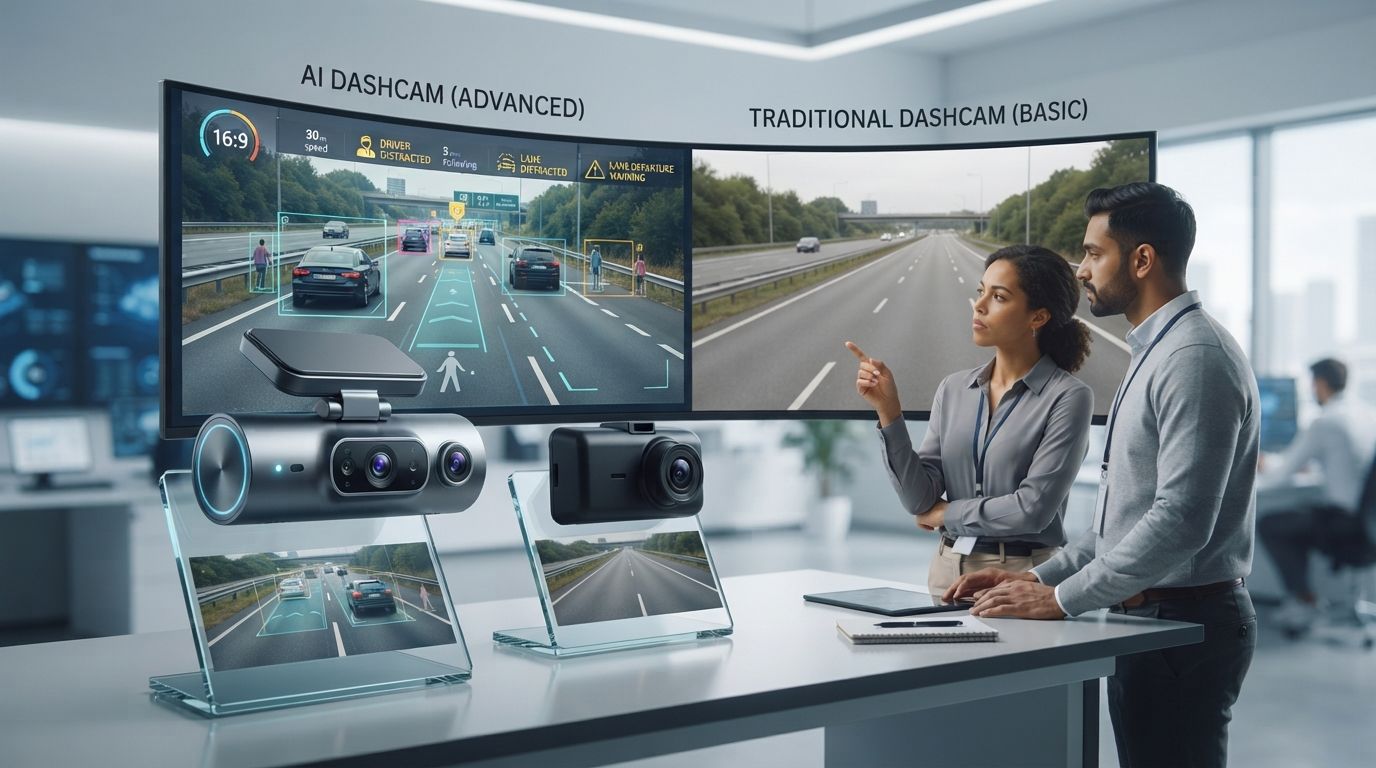
- Advanced Driver Assistance Systems (ADAS): Outward-facing sensors track lane markings, speed limit signs, and the distance between vehicles to warn drivers of forward collision risks, pedestrian crossings, and unintended lane departures.
- Driver Monitoring Systems (DMS): Inward-facing cameras equipped with infrared sensors (for night-vision capability) monitor the driver’s face and eyes. The AI can detect gaze deviation (looking down at a phone), eye closure (fatigue/micro-sleeping), smoking, eating, and seatbelt non-compliance.
- Automated Event Tagging: Instead of sending raw, unorganized footage, the AI automatically tags videos with metadata such as “Distracted Driving,” “Tailgating,” or “Stop Sign Violation.”
- Dynamic Driver Coaching: Cloud platforms aggregate this data to build individual driver safety profiles, automatically assigning coaching modules based on the specific behaviors flagged by the AI.
AI Dashcams vs Traditional Dashcams: Side-by-Side Comparison
To clearly illustrate the differences between these two technologies, the table below breaks down their capabilities across critical operational categories:
| Feature / Capability | Traditional Dashcams | AI-Powered Dashcams |
| Reactive (Post-incident evidence gathering) | Proactive (Active collision prevention and real-time alerts) | Primary Safety Mode |
| Basic G-sensor (impacts, harsh braking, sharp turns) | Computer vision + G-sensor (detects behavior, objects, and forces) | Event Detection Mechanism |
| None or basic beeps for G-sensor thresholds | Real-time voice or audio alerts for specific behaviors (e.g., “Please keep your eyes on the road”) | In-Cab Feedback |
| None (requires manual review of cabin footage) | Instant detection of phone use, smoking, seatbelts, and fatigue | Distracted Driving Detection |
| Manual SD card pull or cellular upload post-trigger | Instant cloud streaming, automated event uploads, secure remote retrieval | Video Retrieval & Storage |
| High (sifting through hours of footage or false G-sensor alerts) | Low (AI filters, categorizes, and prioritizes critical events only) | Manager Review Time |
| Manual process based on historical incidents | Automated driver scorecards, gamified safety ranks, and targeted coaching | Coaching & Gamification |
| Lower hardware costs; minimal or no monthly subscription fees | Higher initial hardware cost; monthly SaaS subscription for AI cloud features | Upfront & Ongoing Cost |
Deep-Dive: Which Is Better for Fleet Safety?
When evaluating AI Dashcams vs Traditional Dashcams: Which Is Better for Fleet Safety?, we must analyze how each technology performs in real-world scenarios. Safety is not a singular metric; it encompasses accident prevention, driver behavior modification, legal protection, and operational efficiency.
1. Preventative vs. Reactive Safety
The core philosophy of a traditional dashcam is to act as an objective witness. While having a video record of an accident is incredibly valuable for insurance claims, it does nothing to protect the physical well-being of the driver or the public during the moment of crisis. If a driver falls asleep at the wheel, a traditional camera will record the tragic sequence of events, but it cannot stop it.
An AI dashcam, conversely, is an active safety device. By monitoring eye-blink rate and head position, the DMS can detect a micro-sleep event before the vehicle drifts out of its lane. An immediate, high-volume in-cab alarm wakes the driver, prompting them to pull over safely. In this battleground, AI dashcams are objectively superior because they actively work to reduce the frequency and severity of accidents, rather than simply documenting them.
2. Eliminating Distracted Driving
According to the Federal Motor Carrier Safety Administration (FMCSA), distracted driving is one of the leading causes of commercial motor vehicle crashes. Traditional dashcams are blind to what happens inside the cabin unless a manager spends hours manually auditing random footage—a task that is virtually impossible for fleets with more than a few vehicles.
AI dashcams solve this problem through continuous visual auditing. If a driver picks up a smartphone, the AI instantly recognizes the object and issues an audible alert: “Distraction detected.” Because drivers know they are being monitored by an automated system, this instant feedback acts as a powerful behavioral deterrent, drastically reducing mobile phone usage within days of deployment.
3. Streamlined Liability and Exoneration
When a commercial vehicle is involved in an accident, the default assumption of the public and law enforcement often leans toward blaming the larger vehicle. Commercial fleets are frequent targets for predatory litigation and “crash-for-cash” scams. In these scenarios, quick access to footage is vital.
While traditional dashcams can provide exoneration, retrieving the footage can be problematic if the camera is damaged in the crash, if the SD card becomes corrupted, or if the driver fails to secure the file. AI dashcams mitigate this risk by immediately uploading high-definition video of the seconds leading up to, during, and after an impact directly to the cloud. Fleet managers can access the footage within minutes of the incident, allowing them to provide instant proof of innocence to law enforcement at the scene, saving thousands of dollars in legal fees and protecting the company’s reputation.
4. Driver Coaching and Performance Analytics
Improving fleet safety requires a cultural shift toward safer driving habits. Traditional dashcams offer little support here, as managers lack the structured data needed to build objective training programs. This often leads to subjective coaching, which can cause friction between drivers and management.
AI dashcams turn raw video into actionable data. By generating automated driver safety scores based on real-time infractions (such as speeding, tailgating, and harsh driving), these systems remove bias from the equation. Drivers can track their performance via mobile apps, participating in friendly, gamified competitions to achieve the highest safety rating. Managers can focus their coaching efforts exclusively on the high-risk drivers flagged by the system’s dashboard, making training highly targeted and efficient.
Overcoming Implementation Challenges: Privacy and Integration
Despite the clear safety advantages of AI dashcams, some fleet operators hesitate to adopt them due to concerns surrounding driver privacy and system integration. Understanding how to navigate these hurdles is crucial for a successful deployment.
Addressing Driver Privacy Concerns
Drivers are often resistant to inward-facing cameras, viewing them as an invasive “Big Brother” tool. This pushback can lead to high driver turnover if not handled correctly. To ease these concerns, modern AI platforms offer customizable privacy settings. For example, the camera can be configured to process DMS data locally without saving or uploading continuous in-cab footage to the cloud. The cloud only receives short, encrypted clips when a severe safety infraction occurs. Furthermore, fleet managers must communicate transparently that the system’s purpose is not surveillance, but rather protection against false accusations and life-saving intervention.
Seamless Hardware and Software Integration
Deploying a fleet-wide technology upgrade requires robust infrastructure. The dashcams must integrate seamlessly with existing Electronic Logging Devices (ELDs), GPS tracking systems, and vehicle engine diagnostics (CAN-bus data). This is where professional managed IT and telematics services become invaluable. Partnering with a specialized provider, such as Sevcore Technologies, ensures that your hardware is professionally installed, your network is secure, and your cloud integrations are configured correctly to maximize system reliability and data security.
The Financial ROI: Are AI Dashcams Worth the Investment?
While traditional dashcams have a low barrier to entry financially, they should be viewed as a sunk cost with limited return. AI dashcams, despite their higher upfront hardware costs and recurring software subscriptions, deliver a rapid and compounding return on investment (ROI) across several areas:
- Reduced Accident Costs: By preventing even a single major collision, an AI dashcam system can pay for its entire fleet-wide deployment instantly.
- Lower Insurance Premiums: Many commercial insurance providers offer premium discounts (often ranging from 5% to 15%) to fleets that deploy active AI safety systems with DMS and ADAS capabilities.
- Exoneration Savings: Rapid exoneration prevents costly legal battles, out-of-court settlements, and hikes in insurance deductibles.
- Fuel and Maintenance Efficiency: The real-time feedback that discourages harsh braking, rapid acceleration, and speeding naturally leads to lower fuel consumption and reduced wear-and-tear on brakes, tires, and engines.
Key Takeaways
- Active vs. Reactive: AI dashcams proactively prevent accidents through real-time in-cab alerts, whereas traditional dashcams only record incidents after they occur.
- Comprehensive Monitoring: AI systems utilize ADAS and DMS to monitor both road conditions and driver behavior (fatigue, distraction, seatbelt use), which traditional systems cannot do.
- Automated Workflows: AI technology filters out false alarms and automatically categorizes footage, saving fleet managers hours of manual review.
- Rapid Exoneration: Instant cloud uploads ensure that crucial evidence is secured immediately, protecting fleets from fraudulent claims and legal liabilities.
- High ROI: Despite a higher initial cost, AI dashcams deliver significant savings on insurance, fuel, vehicle maintenance, and legal expenses.
Frequently Asked Questions
1. Do AI dashcams record the driver continuously?
While AI dashcams process the cabin feed continuously to detect distraction and fatigue, most commercial systems do not continuously record or upload this footage to the cloud. Instead, they operate on a privacy-first model where video is only saved and uploaded when a high-risk event triggers an alert, ensuring driver privacy is respected during normal, safe driving.
2. Can AI dashcams work in low-light or night conditions?
Yes. High-quality AI dashcams are equipped with infrared (IR) LED sensors inside the cabin. This allows the Driver Monitoring System (DMS) to accurately track the driver’s eyes, face, and movements even in complete darkness, ensuring 24/7 safety coverage.
3. How do AI dashcams reduce alert fatigue for fleet managers?
Traditional dashcams trigger alerts for every minor bump or pothole due to basic G-sensor limitations. AI dashcams use computer vision to verify if a physical event was actually dangerous before alerting the manager, effectively filtering out false positives and prioritizing only genuine safety concerns.
4. Will deploying AI dashcams lower my commercial fleet insurance?
In many cases, yes. Insurance companies recognize the proven risk-reduction capabilities of AI safety systems. Many insurers offer premium discounts, subsidy programs for hardware purchases, or lower deductibles for fleets utilizing approved AI dashcam platforms.
5. Is it difficult to transition from traditional to AI dashcams?
The transition is straightforward when managed properly. It involves physical hardware installation and software configuration to link the cameras to your fleet management platform. Working with an experienced deployment partner ensures a smooth, rapid rollout without disrupting your daily operations.
Conclusion
When comparing AI Dashcams vs Traditional Dashcams: Which Is Better for Fleet Safety?, the verdict is clear. While traditional dashcams served their purpose as basic digital witnesses, they are no longer sufficient to protect modern fleets against rising operational risks, legal liabilities, and distracted driving hazards.
AI-powered dashcams represent the future of fleet management. By shifting the focus from documenting accidents to actively preventing them, AI technology safeguards your drivers, shields your business from catastrophic legal liabilities, and delivers clear financial returns. Investing in AI dashcams is not merely an upgrade in surveillance; it is a strategic commitment to operational excellence, driver well-being, and long-term business sustainability.